The absolutely latest organic sales figures that I've managed to access, which I received today,

through Bord Bia from TNS, suggest the following for January 2009:
Sales of organic groceries: up 11%
Sales of conventional groceries: up 2.7%
Isn't that amazing? Despite all the hype, despite people's presumptions, despite people presuming the UK reality must always be the Irish reality, sales of organic produce is up 11% on last January's figures.
What's more, only a specific set of barcoded products are tracked by TNS. Organic accounts for a significant ammount of unbarcoded sales (e.g. loose fresh fruits and vegetables at farmers' markets) .
In other words, the true figure of organic sales increases may be higher again.
(Pic from the Wiki creative commons)Below is an article on the statements people make about future spends - these always have to be taken with a pinch of salt, as people always paint themselves well in polls (well as in frugal these days)
According to a recent TNS mrbi survey on consumer spending plans for 2009, all consumer products will be affected by the state of the economy.
The organic sector can perhaps take some solace from the fact that that out of 18 spending options, it is placed 6th from the top, with the top being the least changed consumer spend.
Concerts, renting DVDs and overnight stays all fare far worse. Organic food will not be affected as much as treats - going out to drink - or bigger spends and investments, such as electrical items for the house.
However this consumer self assessment suggests that the spend on organic food will be 2/3 the level of 2008.
In general, it can be taken that the consumer will be more careful and thoughtful, and will put off some of the very big and perhaps unnecessary spends.
It is hard to be certain about how this sentiment will transfer into the weekly shop as the year unfolds, as food is neither a luxury nor a big marquee spend.
The different types of organic food are not demarked in this survey. A generic desire to spend less on organic is not subtle enough to be of much use to the food producer: how different will the organic food spend be on meat and milk when compared to pizzas and popcorn?
In other words, will it be more likely that consumers will think in the same way about their organic food preferences as their conventional ones, by keeping the staples?
Another confusing notion is surveying 100% of people about what only 45% of people actually do - purchase at least one organic item each month.
When I put this to TNS, they stated that �the data has been repercentaged (sic) to exclude those that do not buy organic�.
This then becomes a lottery of self-assessed organic consumers, where the respondents� relative organic spend does not even get taken into account.
Much of the growth in organics in the current decade has come from committed organic consumers expanding their purchasing range of organic food, rather than for new consumers, so the survey gives us little steer on the likelihood of these sales being affected.
There are always issues with aspirational surveys such as this one: in other words surveys which outline what people hope they will do in the future.
Perhaps these sorts of surveys should come with the kind of health warning that comes on a box of 20 Major.
According to this same survey, a full 49% claimed that they would be spending less on cigarettes in the coming year.
What exactly this means to the surveyor and to the surveyed, and how they are reconciled, is a minefield.
According to TNS, �spending less on cigarettes does not mean stopping smoking, but maybe cutting down one or two cigs a day, or switching to a cheaper brand or buying more duty free/illicit.�
Does the smoker hope, as almost all do, that they will just smoke less or even quit? This survey was conducted in the resolution month of January, after all.
In surveys, people tend to paint themselves in a positive light. Frugality is now chic, so promising to yourself that you�ll spend less on organic food probably resonates well with the consumer�s new self image. This may or may not transfer over into behavioural changes.
It is surely noteworthy that organic was in the indulgence category of the survey.
This would come as news to many, especially in the staple end of the market.
If I have another month of organic turnip soup indulgence, with the turnip clocking in at 1.20 in Tescos, I�d hate to see hardship.
However, it is certainly clear that the mainstream consumer is thinking about things never thought of since before the Tiger, and the organic sector like all the others needs to be aware of this.
Value is a combination of quality and price. To convince people of the price, the quality has to be there.
A Micra costs less than a Merc. Everyone knows and understands this. Does everyone know and understand why organic food is good value?
 I use cardboard as a weed barrier and because I want good drainage on the bottom so I can use it more than one year, no rotting. This is great for any kind of path you want to make, and you can throw it down right on top of the weeds too. Here, I'm covering bare gravelly dirt where some pots had been.
 Use a coarse mulch on top that won't break down quickly under foot traffic. Make it twice as deep as you think, it settles; you want all the cardboard covered completely.
 Details on the planting bag.
 The bag set in place and ready for dirt. I filled it 1/3 full with a nice mix that I mixed up in the wheelbarrow: Planting mix, compost, and mushroom compost, with veg food mixed in too.
 Do you have some potatoes like this in the cupboard? These are various organic market spuds that just need to be planted now. Aren't they pretty? A gift from my daughter.
 Four purple potatoes and one gold in this bag, in place, before covering with soil. As they grow, I'll continue to add soil. Territorial says you can expect 10 times yield from what you plant for regular potatoes, and 15 to 20 times for fingerlings. Sounds good to me. And they're so easy to plant and care for. You can buy seed potatoes now at the nursery too. Pick up some other starts if you need them, like onions, lettuce, spinach and peas.
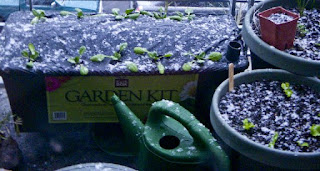
 In other news, the takeout containers win in the germination contest. Tomatoes are up in 4 days.
 Cute baby pac choi.
 Back at the farm, those peas are finally home, with broccoli in front. Moon waning in Virgo, good for transplanting.

 A neighboring kohlrabi crop--this was planted in the fall too and is now ready for the kitchen.

 My view in the community garden, I'm surprised only a couple people are here. We may get a little snow in a couple days, but things are growing and the sun is shining sweet today.
 This is it, my pride & joy, my 4' x 8' box at the community garden. This beauty can grow some food! It's in resting mode with the mulch blanket for the winter. I pulled over 60 lbs. of tomatoes out of here last year, it was a good year. Plus, peas, beans, leeks, basil, potatoes, onions, lettuce, pak choi and strawberries around the back. Some stuff I did in pots; this year I'll be using Potato Bags, a cool container I found at Gardeners' Supply, nice and big and under $10.

 Lots of peas are up now--these were the old seed tests I did. Cool! It's easier to monitor them inside while conditions are iffy and they are vulnerable. They seem happy.

 March 5
 Porch is shapin up...
 according to di plan...